Planar Graphs
Overview
Planar graphs are graphs that can be drawn in the plane without edge crossings.
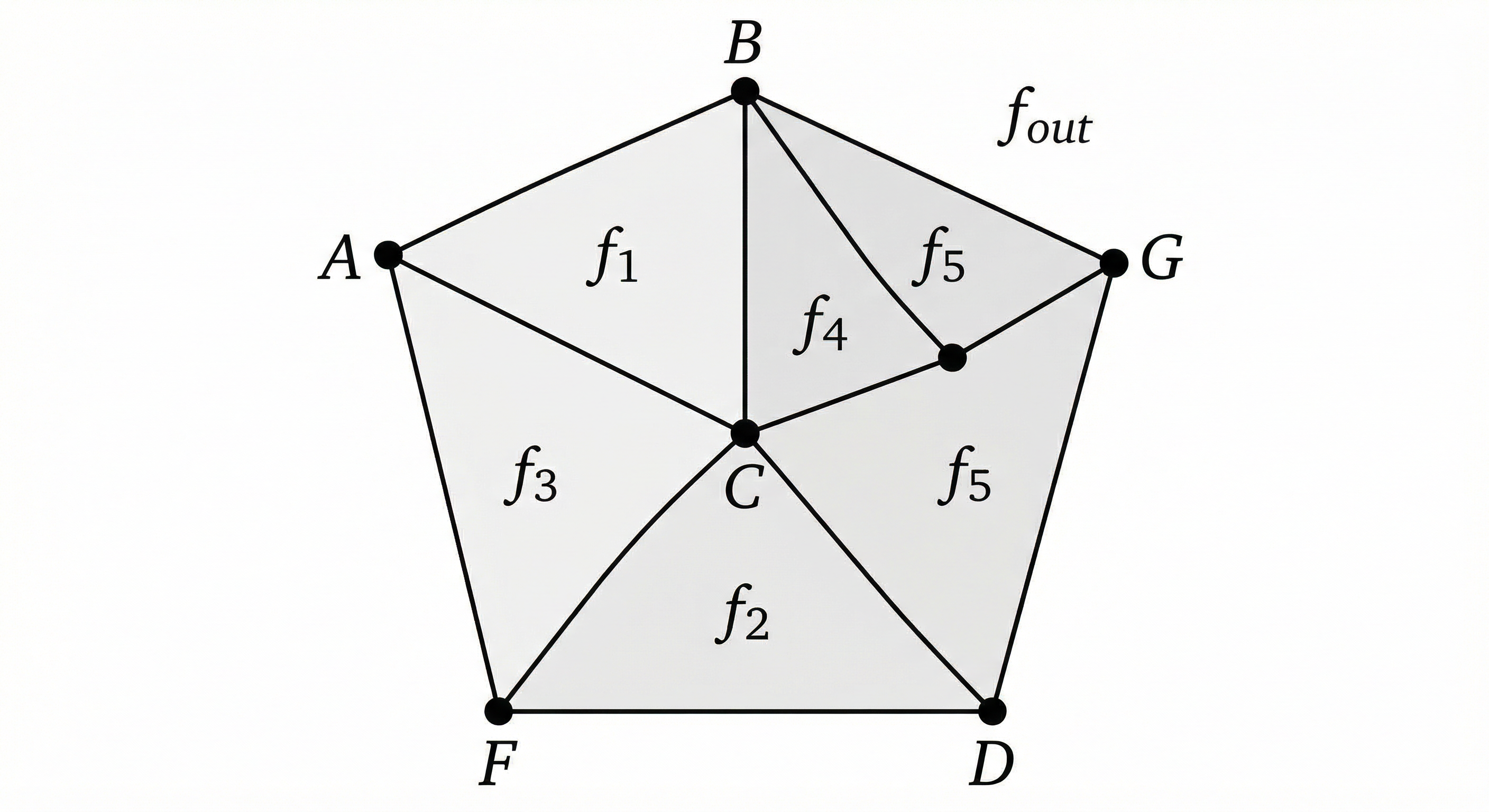
Planar vs plane
- A planar graph is an abstract graph that admits a crossing-free drawing.
- A plane graph is a specific crossing-free drawing (an embedding) of a planar graph.
In an embedding, the edges partition the plane into faces (regions), including the outer face.
Faces and counting
For a connected plane graph, if
- = number of vertices,
- = number of edges,
- = number of faces (including the outer face),
then Euler's formula says:
This simple invariant powers many classic non-planarity arguments and extremal bounds.
Typical proof moves
- Subdivide edges (replace an edge by a path): preserves planarity.
- Add/remove an edge while tracking whether it creates a crossing; in planar proofs, it’s common to remove a non-bridge edge to keep the graph connected.
- Triangulate a connected plane graph (add edges inside faces until every face is a triangle) to derive sharp edge bounds.
Where to go next
Deeper topics