Kuratowski's Theorem
Overview
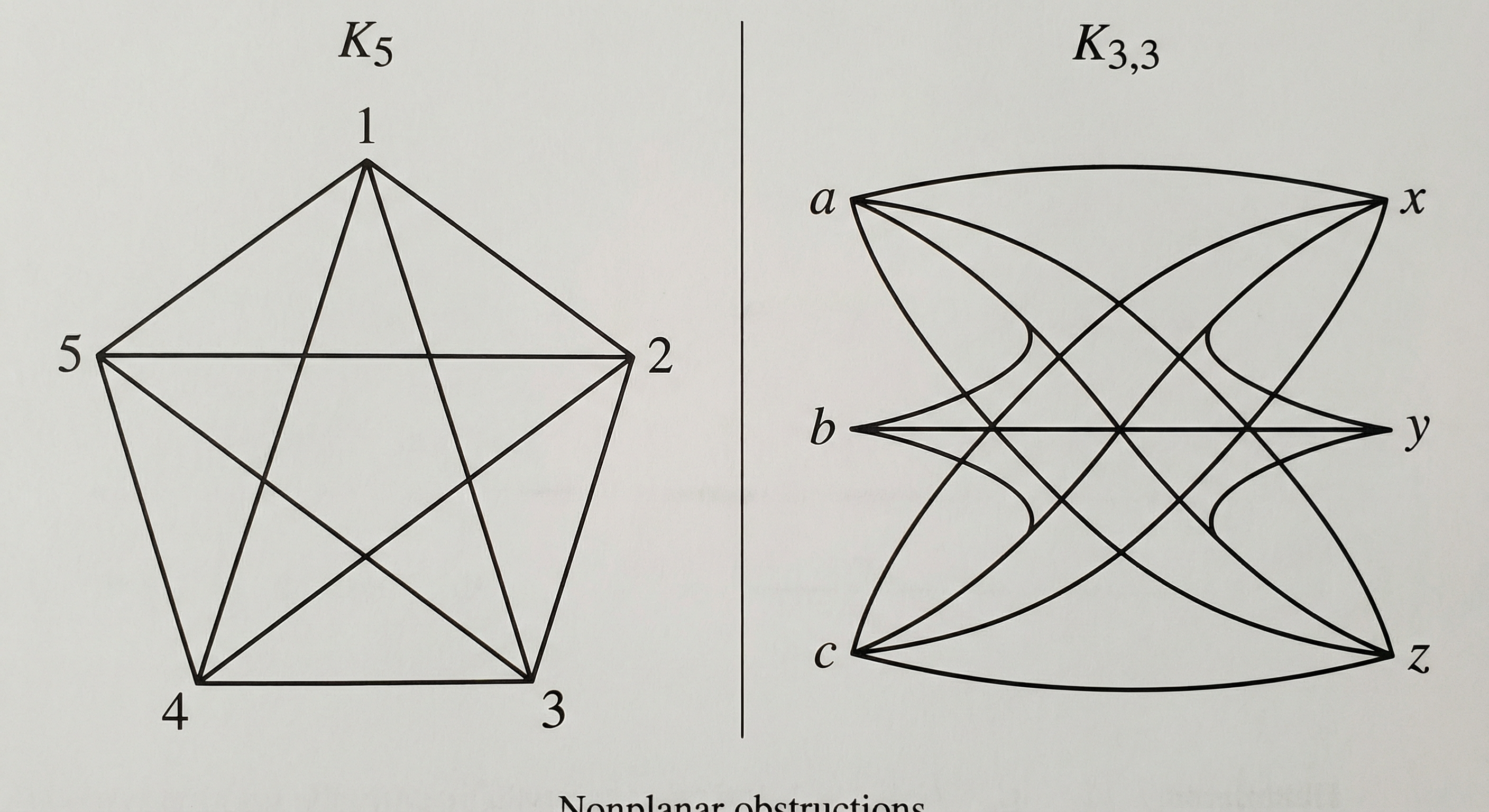
Kuratowski's theorem gives a complete characterization of planarity in terms of two “forbidden” graphs.
Subdivisions
A subdivision of a graph is obtained by repeatedly subdividing edges (replacing an edge by a path by inserting degree- vertices).
Subdividing edges preserves planarity: a drawing of the original edge can be used as the drawing of the whole path.
Statement
A finite graph is planar iff it contains no subdivision of either or .
Equivalently: a graph is nonplanar iff it contains a “hidden” or after suppressing degree- vertices on paths.
How to use it in problems
- To prove nonplanar: explicitly exhibit a subgraph that is a subdivision of or .
- If that’s hard: use Euler bounds first (from Euler's formula) to rule out planarity by counting. Kuratowski is then the “structural” reason behind those obstructions.
In olympiad settings, the most common workflow is:
- simplify the graph (delete degree- vertices, suppress degree- paths),
- hunt for a / subdivision, or
- apply Euler's formula bounds if the graph is dense.