Euler's Formula
Overview
Euler's formula links the basic counts of a planar embedding: vertices, edges, and faces.
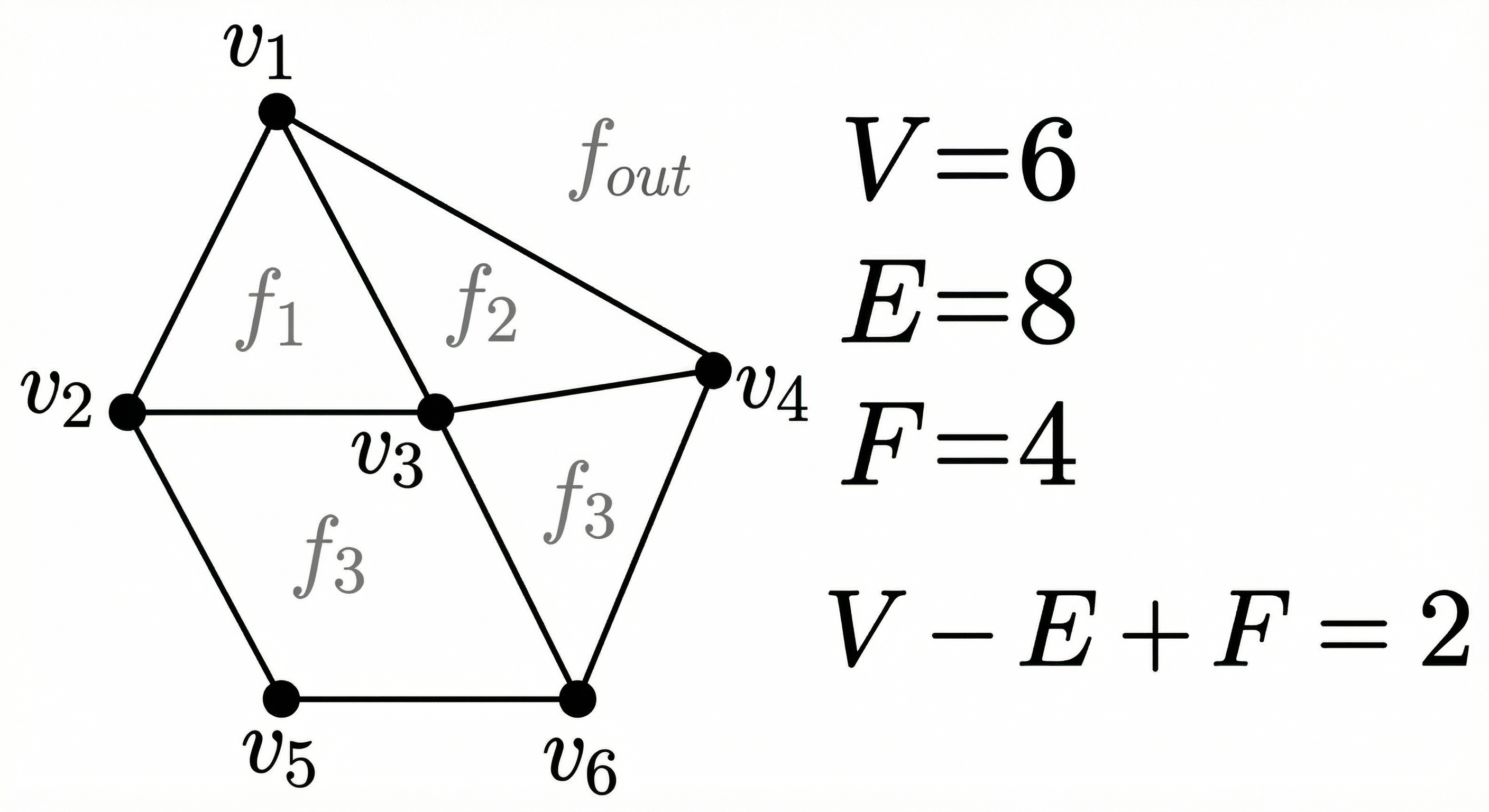
Statement (connected case)
Let be a connected plane graph with
- vertices,
- edges,
- faces (including the outer face).
Then:
Generalization (multiple components)
If the embedding has connected components, then
Proof idea (one clean approach)
Take a connected plane graph.
- If it has a cycle, remove an edge on the cycle. This keeps the graph connected, decreases by , and merges two faces into one, so also decreases by . The quantity stays the same.
- Repeat until you reach a tree (connected and acyclic). For a tree, and , so .
Therefore was all along.
Standard corollaries
Edge bound for planar graphs
If a connected simple planar graph has , then
Reason: in a triangulation, every face has at least edges and every edge borders at most faces, so ; combine with .
Bipartite planar bound
If the graph is bipartite (so it has no triangles), then every face has length at least , giving
Quick non-planarity tests
- For , we have , , but , so is not planar.
- For , we have , , but , so is not planar.